DogCity Documentation
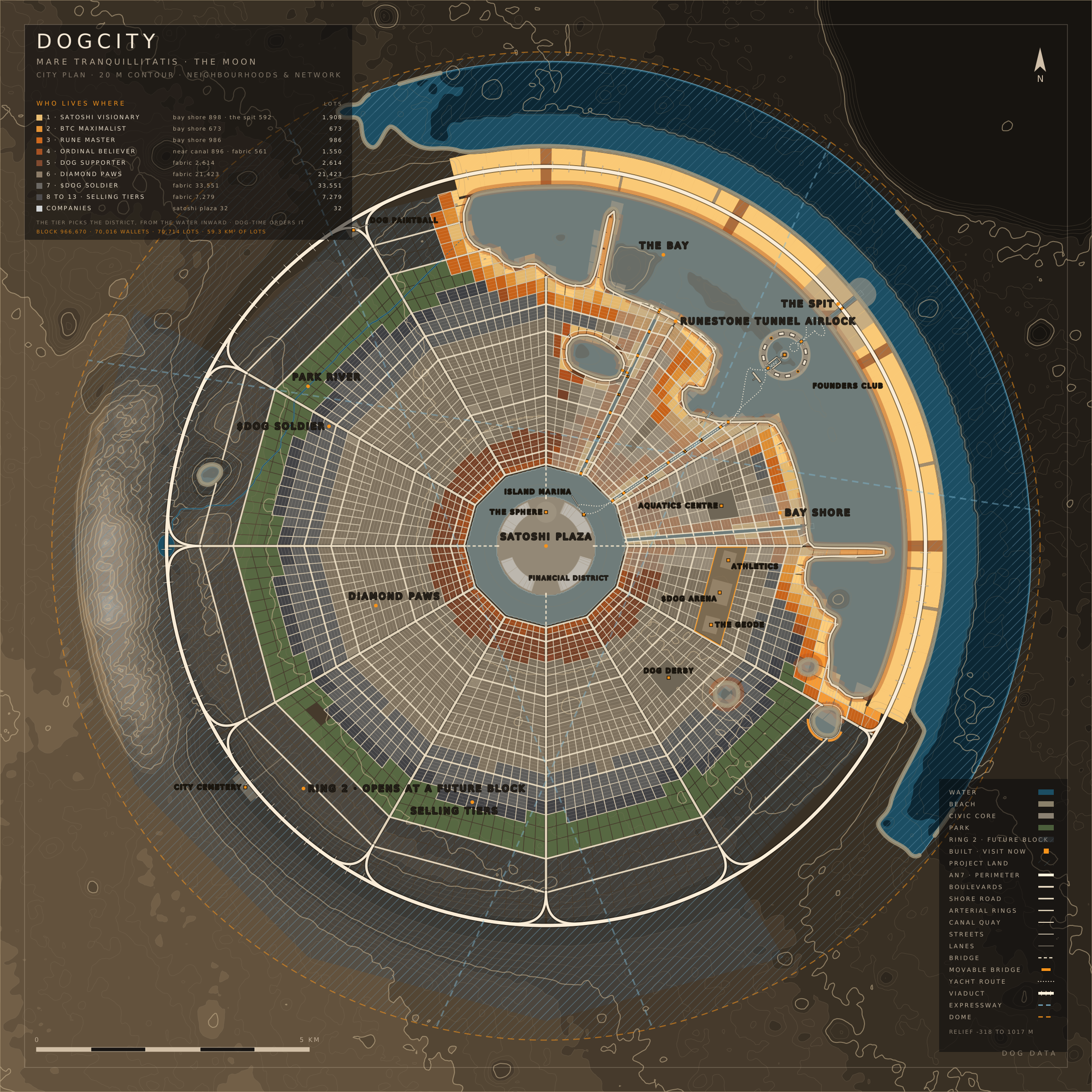
What DogCity is, how the snapshot was built and verified, how land is sized, how the project tells a person from a service, and what the Financial District is. Where each wallet lives follows from the rules in section 4 and is drawn in the city plan below; the lookup on the DogCity page answers it for any address, from the same registry.
 OPEN FULL SIZE →
The city as a book of 51 plates
The atlas draws the same registry as the city plan: relief, water, tiers, streets and landmarks, then 27 registry sheets that place every lot. It closes with the cemetery, the indexes and a pre-release specimen of the on-chain deed. Browse the plates, look up the sheet of any lot id, or download the whole book.
What DogCity is, in one page
DogCity is a virtual city built on real lunar terrain. Bitcoin's territory sits on Mare Tranquillitatis, one of the Moon's dark basaltic plains, mapped from real NASA data rather than a procedural landscape invented for the game.
Every wallet that holds $DOG receives a place on that terrain. Not a place you buy, not a place you pick: a place decided by that wallet's own history on the Bitcoin blockchain. For 70,016 wallets that place is a lot. For the 15,802 that hold less than the smallest lot the city can draw, it is a marble headstone in the city cemetery, and the headstone carries the right to mint a lot later (section 3). The city is not a real-estate product. It is a permanent record of on-chain activity, rendered as a place you can walk through.
Three ideas carry the whole design:
- ·Location is not for sale. A wallet's position comes from its on-chain history at one fixed block. Nothing that can be paid for, licence, donation, or partnership, moves it.
- ·The city is a photograph, not a ledger. A lot's position, size, and district are frozen at the snapshot block, forever. Spending an old coin afterward does not move the building.
- ·Only the building breathes. Height and condition follow the wallet's live balance, computed by the indexer. The lot underneath never changes.
$DOG is the only asset involved. DogCity does not launch a new token, and holding a lot is not equity, an investment, or a yield.
The snapshot
What happened
On 12 September 2026 a single Bitcoin block decided the land allocation of every address holding $DOG on chain. Nothing was claimed, nothing was signed, nothing was registered. The chain was read once, at one height, and the result was frozen.
What was counted
The rune's total supply is 100,000,000,000. The count is 24,406,797.66 short of that figure, and the difference is burned $DOG: destroyed on chain, owned by nobody. What the snapshot counts is what the chain still holds, which is not the same as what circulates. Four addresses widely known to be dead ends, the Bitcoin burn address among them, hold 889,806 $DOG each, one full airdrop allocation, and the city gives each of them a lot like any other address: the rule is the chain, and the chain cannot tell a lost key from a patient one. The project's own API publishes the burn figure at /api/dog-rune/stats.
How it was built
A snapshot is not a photograph of today. It is a photograph of one moment, and the chain kept moving after it.
- 1. The full set of DOG coins was frozen from a state the node had already confirmed, at a height above the snapshot block.
- 2. Every DOG transaction that happened after block 966,670 was then undone, one at a time: coins created after the block were removed, coins spent after the block were put back where they were.
- 3. The result is the set of coins that existed at 11:26:45 UTC, and nothing else.
Balance, coin age, UTXO count, and Runestone ownership were all derived from that same frozen set, so every number in the snapshot describes the same instant. Runestone ownership was pinned to the block too, not copied from today: 31 stones changed hands in the hours after the snapshot, and using a fresh list would have credited 8 wallets that did not hold one at the block and missed 13 that did.
How it was verified
The method can be checked, which is the point. Two things had to be true, and if either was off by a single unit the work was wrong.
- ·Supply conservation. A transfer moves coins, it never creates or destroys them. Rolling the chain back must leave the total untouched. The difference came to zero, exactly.
- ·Set identity. Every coin spent after the block had to reappear, and every coin created after it had to disappear. The two sides matched to the unit, and no wallet came out holding a negative balance.
These checks are not decoration. While the list was being closed they caught real mistakes, including two source files that looked identical and were four blocks apart from each other. A negative balance is impossible, so when one appeared it proved the inputs were wrong, not the arithmetic. The list was only declared finished when both checks came to zero.
The result, sealed
The snapshot is a file. Its fingerprint is published so it cannot be quietly changed: if a single number inside it moves, the hash stops matching.
The first file holds one row per wallet: balance, coin age, UTXO count, airdrop history, Runestone count. The second holds every counted UTXO, by wallet.
Who the snapshot found
| Group | Wallets |
|---|---|
| Received the airdrop and still hold | 26,943 |
| Never received the airdrop, bought on the market | 58,875 |
| Hold a Runestone | 29,011 |
| Hold a Runestone and received the airdrop | 24,942 |
| Never sold a single coin of their airdrop | 19,279 |
| Never sold, and still hold their Runestone | 18,633 |
Those last 18,633 received DOG when it was given away, held every coin of it, and kept the Runestone that brought it to them. On chain, that is the longest patience the data can show.
Every wallet has a tier
Every wallet in the snapshot sits on the same ladder of thirteen tiers, whether or not it ever received the airdrop. The ladder measures what a wallet did with its $DOG from the day it first acquired it: the first acquisition is the starting point and the balance at block 966,670 is the result. For a wallet that received the original airdrop, the starting point is the airdrop itself, measured exactly as the airdrop page always has. A wallet that bought on the open market and showed the same conviction lands in the same tier.
| Tier | From the first acquisition | Wallets |
|---|---|---|
| Satoshi Visionary | +1,000% or more | 1,908 |
| BTC Maximalist | +500% to +1,000% | 673 |
| Rune Master | +200% to +500% | 986 |
| Ordinal Believer | +50% to +200% | 1,550 |
| DOG Supporter | above 0% and below +50% | 2,614 |
| Diamond Paws | holds exactly its first acquisition | 21,423 |
| $DOG Soldier | never sold, below one airdrop allocation | 45,999 |
| HODL Hero | 90% or more retained | 564 |
| Steady Holder | 75% to 90% retained | 691 |
| Profit Taker | 50% to 75% retained | 1,524 |
| Early Exit | 25% to 50% retained | 1,466 |
| Panic Seller | 10% to 25% retained | 1,372 |
| Paper Hands | less than 10% retained | 5,015 |
Three rules hold the ladder together. To sit in any accumulation tier, or in Diamond Paws, a wallet must hold at least one full airdrop allocation, 889,806 $DOG, at the snapshot: that is where every airdrop wallet started, so the bar is the same for everyone. A wallet whose first acquisition was below 10,000 $DOG does not climb the multiplier ladder, however much it grew, and counts as a DOG Supporter. The six selling tiers measure what was sold, so they carry no minimum.
Receiving the airdrop earns the Original Airdrop Receiver badge (26,943 wallets). A wallet that held a Runestone at the snapshot gets the stone planted in the front garden of its lot (29,011 wallets). Neither one changes a tier, a lot size or an address. Companies, known by a public label or by the institutional behavior measured in section 4, are not on the ladder: 33 were found at the snapshot, and 32 of them have their own address inside Satoshi Plaza (section 5). The 33rd, Merlin Chain, held 1 $DOG at the block and receives a headstone like any wallet below the line of section 3. For 158 wallets the chain record of the first acquisition is incomplete, so the starting point is the oldest coin each one still held at the snapshot.
How land follows the coins
Lot area grows with the square root of a wallet's $DOG balance, between a floor and a cap:
Square root is the whole point. Doubling a balance does not double the land, it multiplies it by 1.41. A city where land grew in a straight line with money would be owned by six wallets.
| A wallet holding | Receives a lot of |
|---|---|
| 1,000 $DOG | 31 m2 |
| 20,000 $DOG | 140 m2 |
| 101,779 $DOG (the median holder) | 315 m2 |
| 889,806 $DOG (one full airdrop allocation) | 931 m2 |
| 10,000,000 $DOG | 3,119 m2 |
| 1,644,000,000 $DOG and above | 40,000 m2 (the residential cap) |
Six wallets reach that ceiling, and all six are companies: they sit in the Financial District inside Satoshi Plaza, where section 5 raises the ceiling to 150,000 m2.
The number that answers the whale question before it is asked:
The largest wallet on the chain holds 56 times more $DOG than the twentieth largest, and receives 6.9 times the land, both of them companies in Satoshi Plaza under the raised cap. That is the square root curve at work: it rewards size without letting size erase everyone smaller.
What the ground actually delivers
The curve is the target. The ground is drawn in rows and blocks, and a row rarely ends exactly where its last lot does: the ground left at the end of a row is shared equally among the lots of that row, and never handed to a wallet from further down the ladder. Near the water the same rule covers the scraps of ground left between the front row and the blocks behind it: each scrap was added to the lot that touches it, 192 lots in all, none of them past twice the size it had, and the dead-end lanes that served no lot were removed. Around the second lake a shore road now closes the loop, and the 19 lots that stood on its edge were moved to the band just outside it: same wallets, same tier, same area. Lots that face the water run to the water line, and on the Spit a lot runs from the perimeter avenue to the beach, so eight lots there pass the 40,000 m2 residential cap: the cap limits the target, not the ground a waterfront lot reaches. Measured on the registry (17 October 2026), the median lot holds 1.08 times its target, and only 1 lot holds less than 0.95 of it, a company lot in Satoshi Plaza. Your deed states the area the registry holds, and that area, not the target, is what the fingerprint seals and what this site answers when you look your wallet up.
Below the smallest lot: the cemetery
The floor of that curve is not decoration. At 24 m2 a lot is still ground a person can stand on. Below it the curve hands out tiles, not land, and the smallest of them would not fit the 1.70 m figure the city is drawn around. So the floor sets a cut, and the cut is derived, never chosen: 591.95 $DOG is the balance a lot that size takes on the published curve.
A wallet below the line receives a marble headstone in the City Cemetery, an open field cemetery in the American pattern: identical stones, aligned rows, constant spacing. It is a field, not a wall of niches and not a crypt. It stands just outside the perimeter avenue, facing Ring 2, the ring its wallets can come back to, on the city's main axis opposite the mouth of the bay: 540 by 178 m at bearing 231.25, about 7 km from Satoshi Plaza. A 790 m cypress avenue leads to its gate from the arterial ring, across Ring 2 and under the perimeter avenue. The stones face the city in balance order, so the wallet closest to the line stands in the first row by the gate, and each stone carries its number, its address and its balance at the block.
The headstone is a right to mint a lot later, not a closed door. A wallet that holds above the line again, takes the same 10,000 $DOG building licence any other wallet takes in order to build, and mints the deed, receives land in Ring 2, the expansion ring, at a future block that has not been announced yet. Ring 1 froze at the snapshot and nobody moves into it afterward.
Those 15,802 addresses do not leave the record. Every headstone has a fixed number and position in the registry, and the cemetery goes into the registry's merkle root next to the lots, under the same single fingerprint that seals the final list. Deleting 15,802 addresses in silence would break the public audit, and the audit is what makes the map worth anything.
How we tell a person from a service
This is the part of the project most worth explaining slowly, because it is where the city almost got it wrong, and the record of getting it wrong is what makes the final answer trustworthy.
Where this ruler came from
The project's first version of this system only classified wallets that had received the original $DOG airdrop. A wallet that never received the airdrop, no matter how much it accumulated by buying on the open market, carried no tier and had no path to a strong position in the city, however hard it tried.
A member of the community, the user @R_irion66036 on X, pointed this out publicly, in this post: https://x.com/r_irion66036/status/2098835847101477099
That criticism was correct, and it changed the project. The ruler was rebuilt to order all 85,818 wallets in the snapshot by measured on-chain accumulation, independent of whether a wallet ever received the airdrop. Location is set by history, not by money: no contribution and no draw moves a wallet, and each lot is reserved for the wallet that earned it until the claim window closes (section 7). That is the whole point of the city, a record of who was here. But arriving today shuts nobody out. Every $DOG wallet already holds a lot from its own on-chain history, and anyone can still become a Founder by order of arrival, build on the land they already own, and take an entry in the Founders' draw (section 6 covers all three).
The airdrop itself did not disappear from the picture. It became the Original Airdrop Receiver badge: every wallet that received the original airdrop carries this mark permanently, on the record as part of the first community. The badge is identity and legacy, never land and never a return: it pays out nothing, it never changes lot size, and since 28 September 2026 it no longer decides a tier or an address either.
The address follows the tier from section 2, the same ladder for every wallet. The tier chooses the district, and the DOG-time ruler described below orders the wallets inside it. The waterfronts are finite, so they go to the top of the ladder in this order: first the Spit, the causeway that closes the bay, facing the water on both sides (592 lots); then the Bay Shore on the opposite margin, its beach row and its two peninsulas; then the canal fronts and the front row that circles the great lake; then the rows behind the Bay Shore, the lake and the canals; and then the body of the city, from Satoshi Plaza outward. Each tier closes its own rows before the next one starts, so a smaller lot from further down the ladder never fills a gap left inside a higher tier's district. Companies are not on the ladder and have their own address inside Satoshi Plaza (section 5).
Ring 1 ends in a park, a green belt about half a kilometre wide that wraps the last row of lots. Past it, still inside the perimeter avenue, the ground is already drawn as Ring 2: the expansion ring of section 3, which opens at a future block and holds no lot from this snapshot.
Why the problem exists
The rebuilt ruler needed to be a single measure that could order every wallet: how much a wallet accumulated, and for how long it held. Call it DOG-time: for every coin a wallet holds, multiply its amount by its age in days, and add it all up. One number, the same question for everyone, no need to know whether a wallet received the airdrop, bought on the market, or both.
The first time that ruler was run in full, half of its own top ranks were not people. Some wallets held tens of thousands of deposits, one per transaction, every single day for the project's entire history. Others had received deposits from nearly a thousand different addresses. A ruler built to reward patient accumulation was, at the very top, rewarding infrastructure: exchange wallets, bridges, and addresses the project itself uses to distribute funds.
Why it is hard
The obvious fix, exclude anything that looks like a business, runs into a structural wall: custody consolidates. An exchange's wallet does not receive from the public. It receives from the exchange's own internal transfers, which have already gathered everything together. That gives it few counterparties, old coin age, and little turnover per address, exactly the signature the ruler was designed to reward. In the one sense that matters most to a ruler built on patience, a service's wallet looks better than a person's. Nothing about the shape of the coins on chain says "this is a business." The information that a wallet belongs to a company lives in a label, not in its transaction history.
The metrics we tested and rejected
Every one of these was measured against the real wallet population, not judged by eye. Each line is the number that killed it.
- 1.Counting deposits or UTXOs. One wallet had 195 separate deposits and zero signed transactions in its entire history: it bought, repeatedly, and never once proved it controlled the coins by spending them. Counting deposits measures buying, not conviction.
- 2.Buying whole airdrop allocations (a wallet's deposits arriving in exact multiples of 889,806 $DOG, the size of one airdrop allocation). 68 wallets bought ten or more whole allocations and mostly never sold. Worse: five of those wallets received the deposits as the airdrop payout of their own Runestones (holding 38, 16, 13, 14, and 24 stones). A filter meant to catch accumulation would have punished exactly the holders the project promises to reward.
- 3.A repeated, identical deposit value. This only finds the market's own standard lot size: 88,980.60 $DOG, one tenth of an airdrop allocation, shows up in hundreds of perfectly ordinary wallets.
- 4.Signatures per day of the wallet's active window. A cutoff of one signature per day catches 20,871 wallets, a quarter of the entire city.
- 5.Turnover (signatures divided by remaining UTXOs). This catches holders who are consolidating, not cashing out: one wallet held 68 exact airdrop allocations inside a single UTXO and had signed 106 times just to merge them into it. The denominator collapses to one and the ratio explodes, flagging patience as suspicious.
- 6.Distinct payers, counted only from the surviving UTXO (the coins still held at the snapshot). This measure is nearly identical, mathematically, to counting UTXOs (a correlation of 0.9995 across 413 of the top 500 wallets). It rewards a wallet that sweeps its coins into one output, because sweeping erases the wallet's own deposit history, and it punishes a wallet that simply keeps everything it was ever sent.
- 7.Distinct payers, counted from a wallet's complete history. A known exchange address showed 763 distinct payers across 1,334 transactions, which briefly looked like a real line to draw. It was not: a confirmed retail wallet showed 633 distinct payers too, because it had bought 129 whole airdrop allocations from 633 different people and never sold a single coin. It measured right alongside the exchange. A cutoff proposed from a small sample would have wrongly flagged several confirmed people and retail wallets along with it.
What works, and why
The instrument that survived is not one rule but three, plus a hard exit condition, and each targets a different shape of custody.
How we calibrated against outside truth
The strongest evidence available anywhere in the project is a wallet whose owner asked to be verified and paid to prove it: those addresses live in the project's verified-address list, separate from the labels the project deduces on its own from chain data. Three such verified exchange hot wallets, Gate.io, MEXC, and Bitget, sat at the very top of the raw accumulation ruler. Reaching the conclusion "this is a service" for all three, using only blind measurement (circadian rhythm, distinct destinations, volume) before ever looking at which address belonged to which company, is what validated the instrument. That gives confidence in what the same instrument says where no label exists yet.
The DOG-to-Stacks bridge, an address the founder confirmed directly, measured at 63% overlap between depositors and recipients, exactly the bridge signature described above: some transfers show a full round trip, most show partial redemption consistent with migrating funds across chains and holding them there.
What the ruler does not reach, honestly
The ruler only has enough signal to classify where the money actually concentrates. It cannot classify the whole city, and it does not try to.
In the top 500 wallets specifically, 57% have 10 or more deposits, 38% have 20 or more, and 10% have 100 or more: the signal is concentrated exactly where it matters, at the top of the city.
The rule that protects everyone else
A wallet only ever carries the institutional tag if it has sent $DOG at least once, in addition to matching one of the signals above. This is not a technicality: the right of appeal described in section 5 only works for a wallet that notices it was tagged and pushes back. A wallet that received the airdrop and never touched it again cannot appeal, so it must never be exposed to a tag in the first place. That single rule protects 58,695 wallets, 68% of the entire city, that have never signed a transaction of any kind.
Applied once, on the top 500 wallets, the current rule flagged 21 wallets holding 13,660,491,106 $DOG (13.66% of the supply). Eight of the 21 sit in the top 10, fifteen in the top 60. Thirteen of the 21 were caught by only one of the four signals and carry no independent label: those are the fragile calls, and the ones most likely to be appealed.
The Financial District
What it is and why it exists
A wallet's position in the residential city is earned by patient personal accumulation. An exchange, a bridge, or a trading desk never competed on that axis in the first place, and placing one at the back of the line for holding the coins its own customers sent it is not neutrality, it is punishing the entities that brought the project attention and liquidity. The Financial District exists to give institutions their own address, sized by what they hold, without asking the residential ruler to bend around them.
A privilege, not a punishment
Moving a wallet with institutional behavior into the Financial District is not a penalty. It is the arrangement that leaves both sides better off, and both sides need to be argued, because the point is that nobody loses.
For the institution, it is a privilege. It receives an address in the city's commercial center, where visibility is worth something, instead of disappearing into the middle of a residential line that measures a quality it never competed for in the first place. An exchange that brought $DOG a listing and press attention earns a storefront, not a punishment.
For everyone else, it is also a gain. Residential lots go to the wallets that actually live in those neighborhoods, and no person loses ground to an address that is holding coins on behalf of other people.
The residential ruler measures personal accumulation, and an institution never competed on that axis to begin with. Taking it out of that line is not removing it from the city, it is placing it where what it does is exactly what counts. The right of appeal for this tag, documented later in this section, still stands either way: a wallet flagged by mistake, whose owner states the wallet is personal, trades it for a lot of the same standing drawn from the project's reserve.
Where it is
The Financial District sits inside Satoshi Plaza, the city's central precinct (everything within 1,420 meters of the center, 6.33 km2 total), rather than in a ring further out. The plaza was already larger than its current civic program needed, and placing the district there gives it the most prominent address in the city without taking a single lot away from the residential fabric.
An earlier version of this page split the plaza into 30% district, 15% project reserve and 55% civic core. That split counted dry land the plaza does not have: the Plaza Lake takes 2.63 of the 3.79 km2 of the ring. The measured need turned out far smaller than the estimate and fits three times over in the dry land that remains, without touching the water. The largest company lot, 104,004 m2, reaches 69% of the raised cap.
Since 28 September 2026 the rule is wider: every company goes here, whether it is known by a public label (an exchange, a marketplace, a bridge, a desk, a treasury) or by the institutional behavior measured in section 4. That is 33 wallets at the snapshot, 32 of them with a lot here: Merlin Chain held 1 $DOG at the block and has a headstone instead. None of them competes with a person for a residential lot, and none of them sits outside the plaza.
How land is sized inside the district
The district uses the same square-root curve as the rest of the city, with its ceiling raised from 40,000 m2 to 150,000 m2. The residential cap of 40,000 m2 would tie the four largest institutions at the same maximum size, which erases exactly the size difference a financial district is supposed to show. Under the raised cap the curve still holds, and the district is its own proof: its largest wallet holds 14,552 times the balance of its smallest, 12,948,142,549 $DOG against 889,806, and receives 38.6 times the land, 104,004 m2 against 2,691. Measured against the closed snapshot, the 32 companies with a lot hold 30.27% of the supply and take 600,476 m2 in total, or 0.60 km2, with the largest reaching 104,004 m2, about two thirds of the raised ceiling. The district is built and the whole of it fits with room to spare in the dry ring between the precinct wall and the Plaza Lake.
$DOG is listed on 20 exchanges today (source: CoinGecko, 13 September 2026), 14 custodial and 6 on-chain. The project has confirmed the deposit address of 5 of the 14 custodial exchanges so far.
How you enter
Two doors, and it matters which is which. The preferred door is partnership: the exchange or institution comes to the project, proves who it is, and the two enter an agreement. Nothing about that has changed and it is still how we want this to work.
The second door is the one that is actually open today, and the page has to say so. At the snapshot the project ran the person-versus-service ruler of section 4 over the largest wallets and marked 21 of them as institutional. Those 21 were placed in the Financial District by that measurement, not by a handshake, because the city had to be generated and every wallet had to land somewhere. Any wallet marked this way has the right of appeal described below, and a successful appeal moves it to a residential lot of the same standard from the reserve. An exchange that has not reached out and was not marked is not placed there by deduction. A wallet that carries a public label as a company is placed there by that label.
The right of appeal
Not every institutional wallet will have come forward for a partnership by the time the city goes live, and the measurement in section 4 exists precisely to catch the ones that have not, without silently mislabeling anyone. Any wallet automatically tagged as institutional keeps a right of appeal: its owner can state that the wallet is personal and trade it for a lot of the same standing drawn from the project's own reserve, no different in size or quality from the one it gave up.
That right only works because the project holds a standing reserve everywhere it might be needed. The project keeps 1% of the lots in every neighborhood of the city, the Spit included, scattered throughout each one rather than gathered into a single block, so that a lot of comparable standing is always available near wherever an appeal happens to land. The measurement in section 4 flagged 21 wallets, and the reserve covers every possible appeal many times over.
It was 15% while the project still thought it had land to spare, then 2%, and now 1%. The reason it keeps shrinking is worth stating plainly, because it is the same reason every time: every point of reserve costs a point of area for everyone else. The large land bank the project wants for itself belongs in the expansion ring, not in the middle of Ring 1, and the reserve inside the neighborhoods exists for one job only, which is to back the right of appeal.
The Founders Program
Founders are a separate track from the residential city: a way to fund and unlock the city's construction, layered on top of a wallet's own lot from section 3, never a substitute for it. A wallet's Original Airdrop Receiver badge, tier, and lot never change because of anything in this section.
The construction fund address
These are the only addresses the construction fund uses. They are published here on purpose, away from the screen that takes the payment, so that anyone can check what a payment screen shows before sending anything. If an address on any page does not match one of these, do not send, and tell us.
The strongest check is not this page either: a connected wallet shows the destination in its own confirmation screen, which no script on our site can change. Prefer that path.
What a Founder is
A Founder is any wallet that contributes to the city's construction fund before the fund reaches 10,000,000 $DOG. There is no cap on the number of Founders: what closes the door is time, not a seat count. Contributions are counted per wallet and add up across several transactions, and a wallet's Founder number is assigned by order of arrival, meaning its first contribution, never by how much it eventually gives. Contributing more later never moves the number.
Three axes
Everything a Founder receives sits under one of three ideas: Seen, the building stands on opening day and carries a marker only Founders have; Remembered, the name on the Founders' Monument and the number on the facade; and First, mints before the doors open and sits inside every test and update before anyone else.
The ladder
Every rung includes everything in the rung below it.
A name on the Founders' Monument in order of arrival, a permanent Founder number never issued again, access to the Founders Club on its island in the city's bay, and one entry in the Founders' draw. There is no building licence below 10,000 $DOG: the recognition is permanent either way, and the order number is the one thing that cannot be obtained later.
Adds a one time, permanent building licence; minting first, free, in the Founder phase, so the building stands on day one; early access to the game, to every test and every update; the Founder's light on the building, visible from above at night; and a base item pack (yard and house number plaque).
Adds an extended item pack (leisure ground, garden, lighting) and a lunar rover parked on the lot.
Adds naming a street, with the name staying on the city map, and a custom building designed outside the district catalogue. This is the one exception to the rule that every district keeps its own architecture, which is why the privilege stops here: personality lives in the items around a house, not in the house itself.
The Founders' draw
One draw, among every Founder at any rung, on an announced date. Prizes: a Runestone, held by the project and given away once; a custom building, the Patron privilege granted to a winner at any rung; a street name, chosen by the winner and printed on the city map; and the 1 of 1, the first lunar rover ever minted, the only one of its kind. No lot is ever drawn: where a wallet lives is decided by its Bitcoin history at block 966,670, never by a contribution. Only a lot its owner leaves unclaimed goes on sale (section 7).
Soulbound versus transferable
Founder and achievement items are soulbound: they prove something a wallet did, and that proof cannot be bought. Catalogue items, bought from the store, are transferable: they are taste, so they can trade. The split gives the city a real item market without turning merit into merchandise. The lot deed is transferable too: it is land, and once minted it can change hands (section 7).
What a Founder is not
Not equity, not an investment, not a yield. DogCity launches no new token: no staking, no APY, no emissions, no parallel economy. Everything runs on $DOG, which already exists on Bitcoin and is already distributed. Being a Founder never moves a wallet's own lot, and it never moves anyone else's either.
How the mint works
Every lot in the registry becomes an Ordinal on Bitcoin L1: a deed, inscribed as a child of the City Charter, the map that parents the whole city. The deed draws the lot as a surveyor's plat, with its corners, its area and the Merkle proof that ties it to the registry. It carries no owner data. Nothing has been inscribed yet.
When it opens
The mint is triggered by the construction fund, not by a date. Call B the block in which the fund reaches 10,000,000 $DOG. Every phase is counted in blocks from B (144 blocks is about one day), and the calendar is inscribed on chain once B is known.
- ·Closed, B to B+288 (about 48 hours). Nobody mints. The Founder list is cut at block B, every contribution confirmed up to and including that block, published for 24 hours of review, and then its root is inscribed.
- ·Founder, B+288 to B+720 (about 3 days). Every Founder mints the lot their wallet holds in the registry, free: only the Bitcoin network fee and the 546 sats that carry the inscription. A Founder who has not minted yet keeps that right, free, until the end of the Whitelist phase.
- ·Whitelist, B+720 to B+3,744 (about 21 days). Every wallet with a lot in the registry mints its own lot, for US$1 plus the network fee and postage.
- ·Partners, B+3,744 to B+4,032 (about 48 hours). Holders of partner collections mint any unclaimed lot for US$1.50. In the same window, a Founder whose wallet has no lot, and who contributed more than 592.22 $DOG, picks an unclaimed lot for free.
- ·Public, from B+4,032 until every lot is minted. Anyone mints any unclaimed lot for US$2, in the order payments confirm, up to 10 lots per wallet every 144 blocks.
Your lot, and what happens if you do not claim it
Where a wallet lives is set by its own history at block 966,670, and no contribution and no draw moves it. That lot is reserved for that wallet through the Founder and Whitelist phases, about 24 days from the day the mint opens. A lot its owner leaves unclaimed by then goes on sale in the Partners and Public phases, and whoever mints it holds the deed.
A minted deed is transferable: whoever holds the inscription holds the lot, and it can be sold. The building licence and the items stay with the wallet that earned them. For each lot, the first valid deed is the only one that counts, and the project never inscribes a second one.
Three kinds of lot never go on sale. Lots of exchanges and custodians in the Financial District are held for the company until it proves it controls the address. The 698 project lots stay as the Project Reserve. And a headstone mints its lot in Ring 2 at a future block, never in Ring 1 (section 3).
Paying
Prices are set in US dollars and paid in BTC only. The dollar price is converted at the median of Kraken, Coinbase and Bitstamp when the order is placed, and that amount holds for 15 minutes. You prove your wallet with a signed message that moves no funds, then pay one exact amount to an address that accepts only that deed, and the deed is delivered to your ordinals address. If the network fee climbs above 50 sat/vB the mint pauses by itself and resumes when it falls; the calendar keeps running. Orders for a phase close 6 blocks before the phase ends.
The only place to mint is the page linked from dogdata.xyz. A mint anywhere else is a scam, and no one from the project will ever ask for a seed phrase or a signature that moves funds.
What this is not, yet
- ·No lot has an announced address. The snapshot decides how much land a wallet receives, not where in the city that land sits. The working record that places every wallet is kept in the open while it is drawn, and it is still being redrawn: no address in it has been announced and none of it is final. The version that counts is the one published with the same method, numbers, and fingerprint used here, on the day the city is sealed. It is being redrawn now to follow the tier ladder of section 2.
- ·No deed has been minted. There is nothing to claim, nothing to sign, nothing to pay today. The mint opens 288 blocks after the fund reaches 10,000,000 $DOG (section 7).
- ·Nothing you do now changes the snapshot. Moving coins after block 966,670 does not change what that block recorded, in either direction.
- ·The Financial District is drawn, and nothing in it has been issued. Its 32 lots are sized by the same curve under the raised cap, and section 5 publishes their total area. What has not happened is the deed: nothing there has been minted, and every wallet placed there by measurement keeps the right of appeal. Since 28 September 2026 it takes every company: 33 wallets at the snapshot, 32 of them with a lot.
- ·The city is not reproducible by outsiders yet. The fingerprint of the snapshot is published and anyone can check their own balance and coin age against the chain by hand, but the file itself is not downloadable yet, and no public script rebuilds the list from the chain from scratch. Until both of those exist, nobody outside the project can redo this work end to end.
CONTACT · support@dogcity.space · Support page